
Meloni’ s twilight?
Why Italy’s recent referendum matters

Italian Prime Minister Giorgia Meloni’s defeat in a referendum on judicial reforms could not have come at a worse time. Gone is the aura of invincibility she had cultivated over the past four years. Shattered is her claim she is still the underdog successfully fighting against vested interests. After almost four years at the helm of her country, she now represents the establishment. The rejection of her proposals suggests Italians are starting to look more closely at her record. Time is not on her side. The next parliamentary election is expected in 2027.
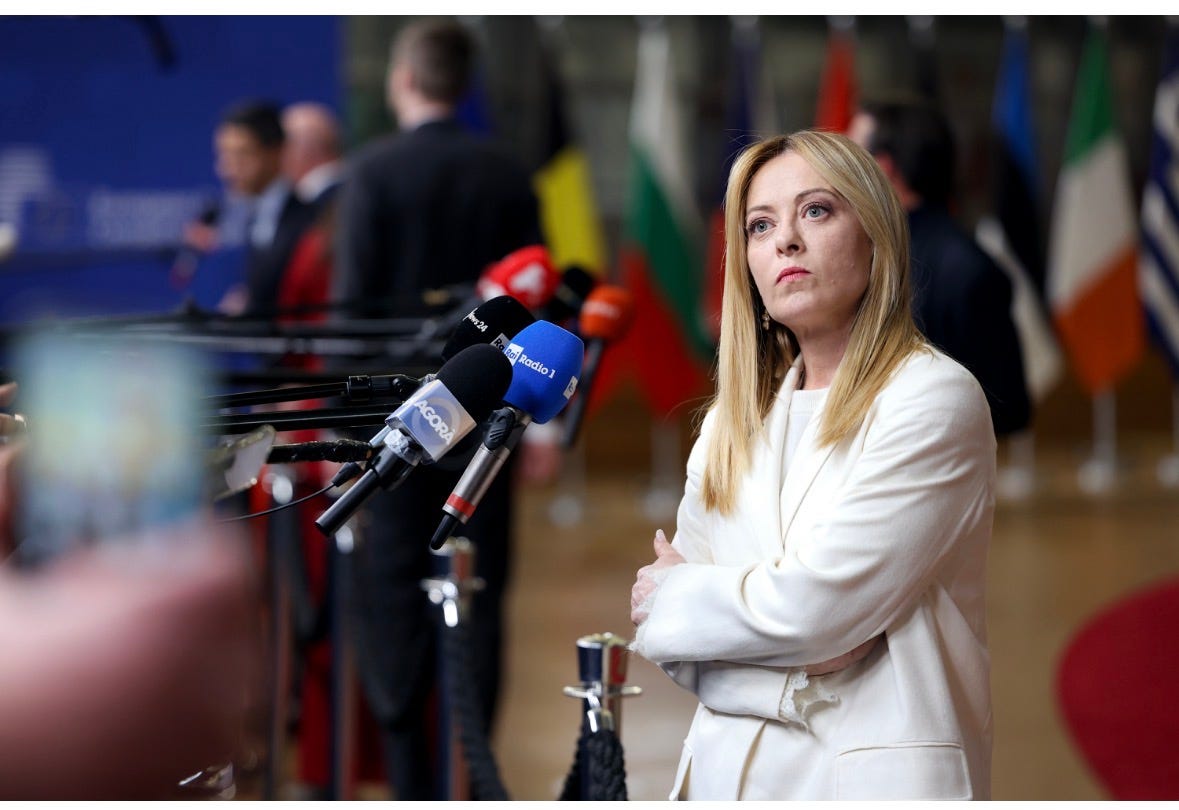
The referendum is a symptom of a larger story, one that goes beyond a poorly managed campaign. In fact, her string of luck was coming undone before the vote. It all started with a small number recently published by Italy’s statistical office highlighting the government was still running a deficit in excess of 3% of GDP in 2025, the threshold which would have permitted Italy to exit the EU’s excessive deficit procedure, and would have bolstered investors’ confidence in the country’s finances.
Italy is a country obsessed by “lo spread”, the premium investors demand to hold Italian treasuries compared to what they ask for German bunds, Europe’s benchmark. Thus, taming financial markets’ traditional skepticism about Italy’s ability to stay out of trouble was arguably Meloni’s most important claim of success. In an interview with Bloomberg at the beginning of the year Meloni proudly reminded her interlocutors that the spread was “around 235 points when we took office and is now stable around 60. This is clearly not just an issue of reputation but it is also a matter of economics because it means we save what would be spent on interest on the debt.” In the same interview she stressed that the “element of stability in Italy has completely made the difference; we have to consider that. The stability this government has had – since stability also means predictability for those who invest – makes all the difference. (…) When you have a longer time horizon, you can afford to put a strategy in place without spending the resources to get immediate results, because you have time to see those results.” Contrary to her plain speaking, populist persona, this is a rather Merkelian way of suggesting she represents a safe pair of hands, that in Italy there are no credible alternatives to her prudent handling of her country’s finances and economy.
One of Meloni’ s biggest problems is that her domestic stability has been serially shaken by a main international ally that thrives on instability. With Donald Trump in the White House the tide has increasingly turned against Giorgia Meloni.
The referendum only highlights widening cracks in the stability narrative. Granted, since Trump’s military ‘excursion’ into Iran, the ‘spread’ has not moved much. But that is a pyrrhic success when stacked against rising yields for public debt pretty much everywhere, including Italy. The fact is Trump’s war is reducing Italy’s fiscal space a year before the general election. This wouldn’t matter much if the economy was in good health. The problem is it is not. Confindustria, Italy’s influential industry lobby estimates that even if the war ended in the next few weeks, growth in 2026 would not exceed 0,5%. If the bombing goes on Italy would barely manage to avoid a recession. Even amongst European peers, Italy is particularly vulnerable to energy bottlenecks and war induced inflation:
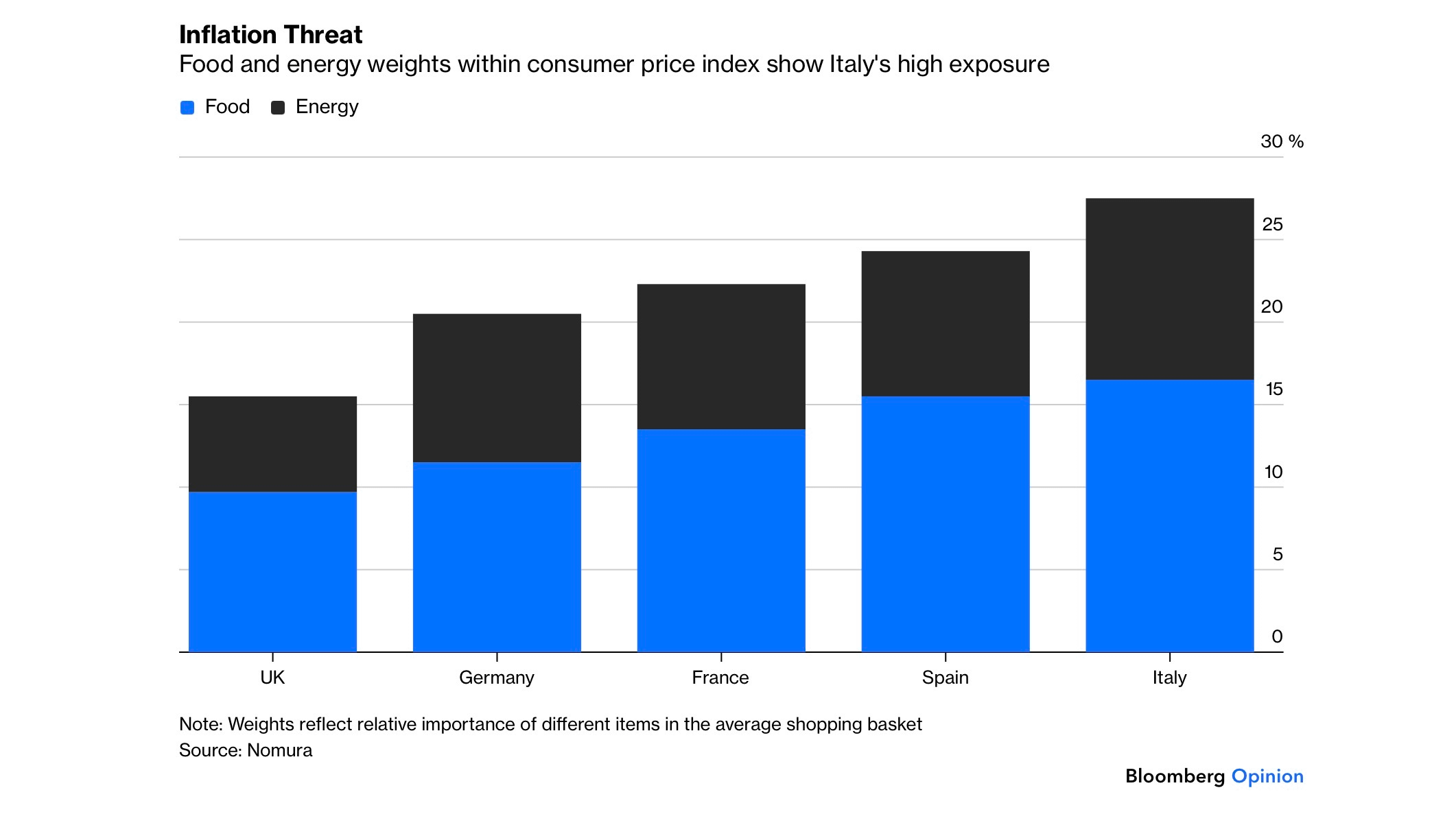
That doesn’t mean Italy is facing an energy crunch remotely comparable to 2022 when the war in Ukraine started. Still, Meloni’s government is struggling to replace the loss of Quatari gas. Even if Algeria, Italy’s biggest gas provider, was to increase flows, Rome would still face a significant shortfall. All this comes at a time when her government routinely blames the so-called EU mandated green transition for rising energy prices and, as a result, has slowed down her country’s transition to renewables. As to Rome’s recent rediscovery of nuclear energy, if pursued it will take years to make a difference.
To avoid being blamed for factors that are, but only in part, beyond her control, in recent months Meloni has started to point the finger at the regulatory overreach in Brussels. She has forged an ad hoc alliance against European bureaucracy with the equally incensed German Chancellor Friedrich Merz, another key EU leader who is desperately seeking to unshackle his own economy.
However, indulging in the typical blame game with the EU executive is not a risk free undertaking. For one the Brussels based institution is already trying to address its own tendency to overregulate. More importantly, Meloni still needs the Commission’s help. Serial attacks would risk undermining the delicate relationship with its head Ursula von der Leyen, jeopardize Meloni’s ability to extract concessions, - not least on exiting the excessive deficit procedure - , and erode the investors’ confidence she has so carefully cultivated. Lastly, undermining Europe would weaken her position within the bloc and make Europe even more vulnerable. Hence, Meloni’s reluctance to engage in frontal attacks.
But Meloni’s temptation to play the blame game presents an even bigger problem. The key driver behind the main economic shocks of the past 12 months, from tariffs to the war, is not the technocratic machine in Brussels but rather the US President, Donald Trump. By stubbornly sparing him from her criticism, Meloni is increasingly losing credibility before Trump wary Italian voters who seem to have concluded there are little advantages in soothing the mercurial president. Given Meloni’s claims of closeness to Trump and his agenda, that puts her at a competitive disadvantage vis a vis most of her EU peers who feel a bit more free to speak their mind on the president. And since any visible distance between her and the president risks undermining the narrative of a cohesive and unstoppable nationalist populist tide that is sweeping the entire so-called West, Meloni, more than most EU leaders, will continue to refrain from vocally criticizing him.
The problem with the recent referendum is that it also all but shuts down another route she had used to suggest she is a bold politician, namely institutional changes. A disappointend Meloni now claims Italians are reform resistant. Perhaps the simpler truth is that by defending the constitution, Italians’ reminded her to focus on what really matters to them. Rather than tinkering with the constitution or engaging in culture wars, what most voters want in uncertain times is to be reassured about the economy. With growth stalling and possibly even going into reverse the Italian Prime Minister is right to be nervous. To be sure, highlighting political stability can be very useful, until it suddenly looks insufficient. In fact, when it becomes an end in itself stability morphs into immobility.