
Mission impossible
How Germany’s chancellor Friedrich Merz is squandering the political capital he never had

German chancellor Friedrich Merz recently turned 70. But even on his birthday the embattled politician could not help but dismiss a rare shower of public praise with sarcasm. At his age, he explained, he knows what’s behind effusive displays of political affection. There are good reasons for Merz’s skepticism. Since he came back from his long walk in the political wilderness his relationship with Germans has remained cool and distant. According to a recent poll a mere 16% of German voters expect the chancellor to serve a second term. That is, if he manages to complete the current one.
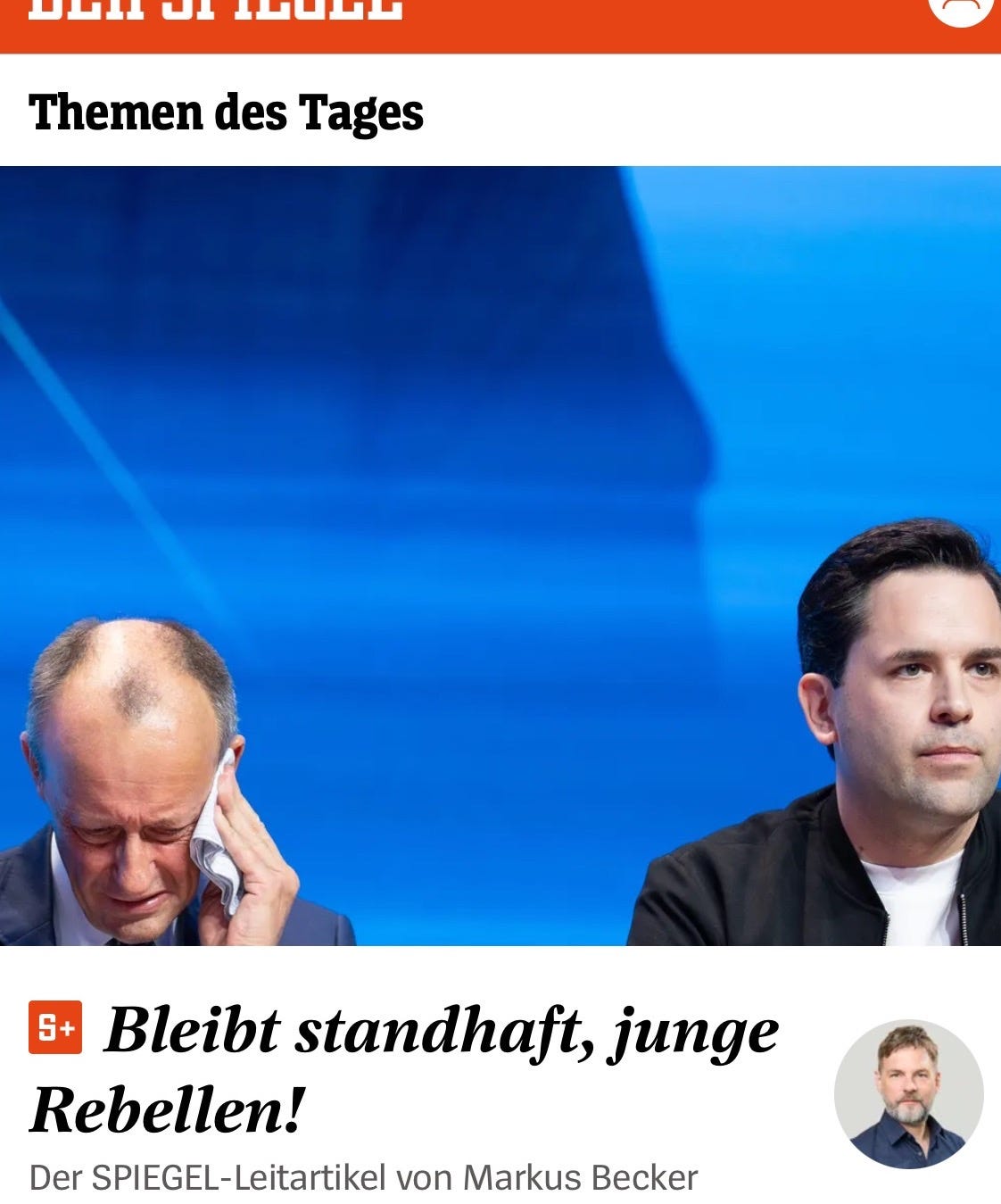
For months his party, the christian democrats from the CDU/CSU, have struggled to shake off right wing populists of the AfD in polls. A recent compromise on Germany’s pension system, reached after lengthy negotiations with Merz’s coalition partner, the social democrats, triggered a firestorm within conservative ranks. Widely seen as a costly gift to the older generation at the expense of young Germans, the compromise was attacked by the youth wing of Merz’s own party. It now threatens to vote against the measure in the Bundestag, Germany’s lower chamber. Many media outlets are encouraging the ‘young rebels’ to stay the course, even if it meant the end of the government.
Gabor Steingart, a columnist, credits Merz with having a lot of good ideas to fix Germany’s ailing economic model but he « mistakes determination for effectiveness. Determination without powerful political networks that support and amplify it (…) will prevent his rhetoric from becoming reality. In other words, the best thing about Friedrich Merz are his intentions. » Ouch.
According to the influential FAZ (Frankfurter Allgemeine Zeitung) a growing number of christian democrats are starting to think the unthinkable, namely to abandon the coalition partner, the SPD, which they see as set on a course towards political oblivion, and focus on their own survival. If that means leading a minority government with outside support from the AfD, so be it. Some christian democrats believe that unless bolder reforms are enacted, the government risks the fate of the previous one, roundly dismissed by voters as one of the most hapless in the history of the republic. German media are already busy looking for possible conspirators, ready to plant the dagger into Merz’s not so grand coalition. There is no panic yet, but we are inching closer. Unfortunately, historically, little to no good has ever come from having panic and Germany appearing in the same sentence.
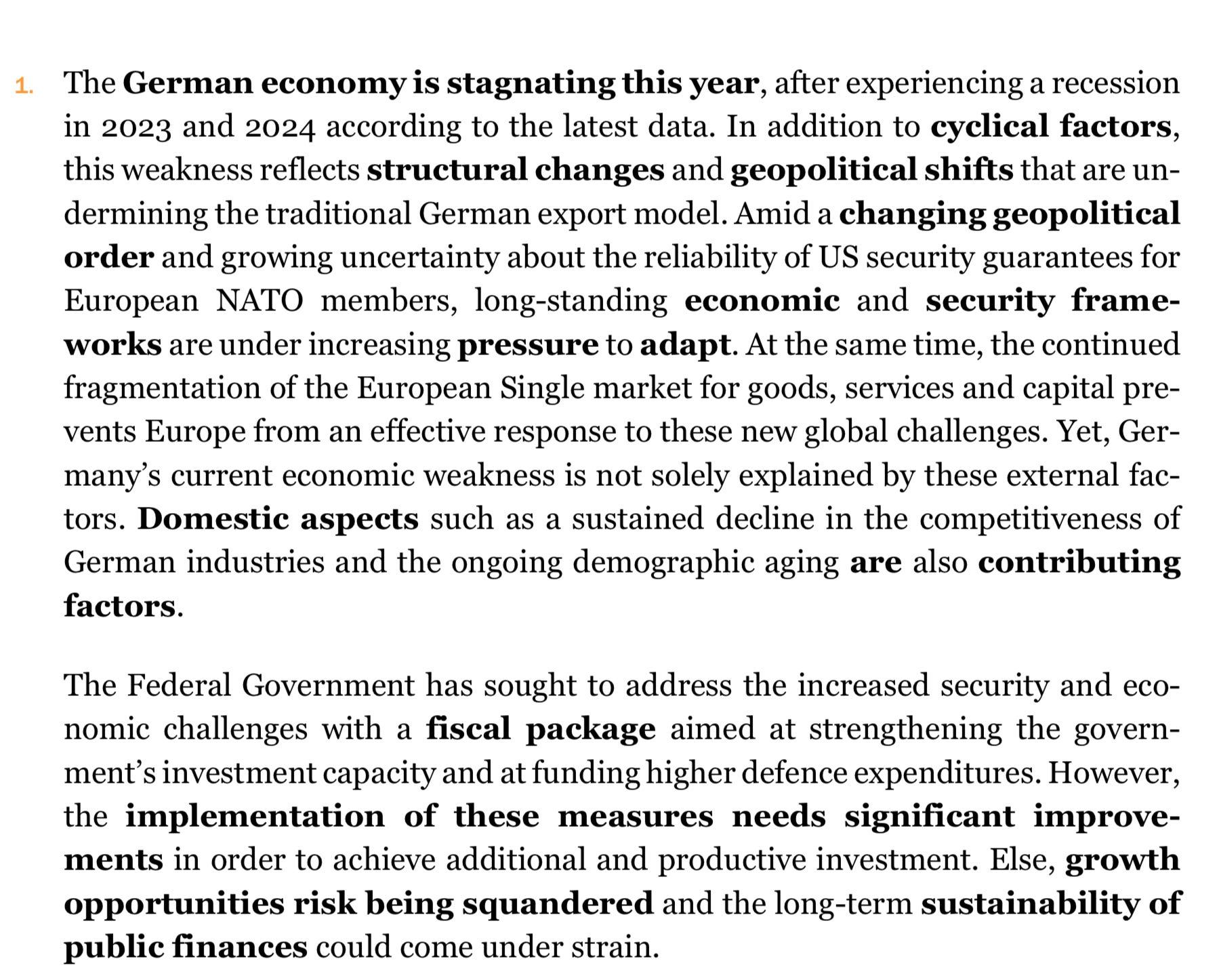
The reason for the current media frenzy? Of course it’s the economy, stupid. In their recent economic outlook the German council of economic expert, a leading advisory body for the government, painted a grim picture of this year and next.
The economists urge a series of steps. They all have one main objective, which is to invest into the future rather than waste money on short term palliatives. I don’t want to selectively highlight their reccomendations. Here is a table with the main challenges the group thinks the government should urgently work on. :
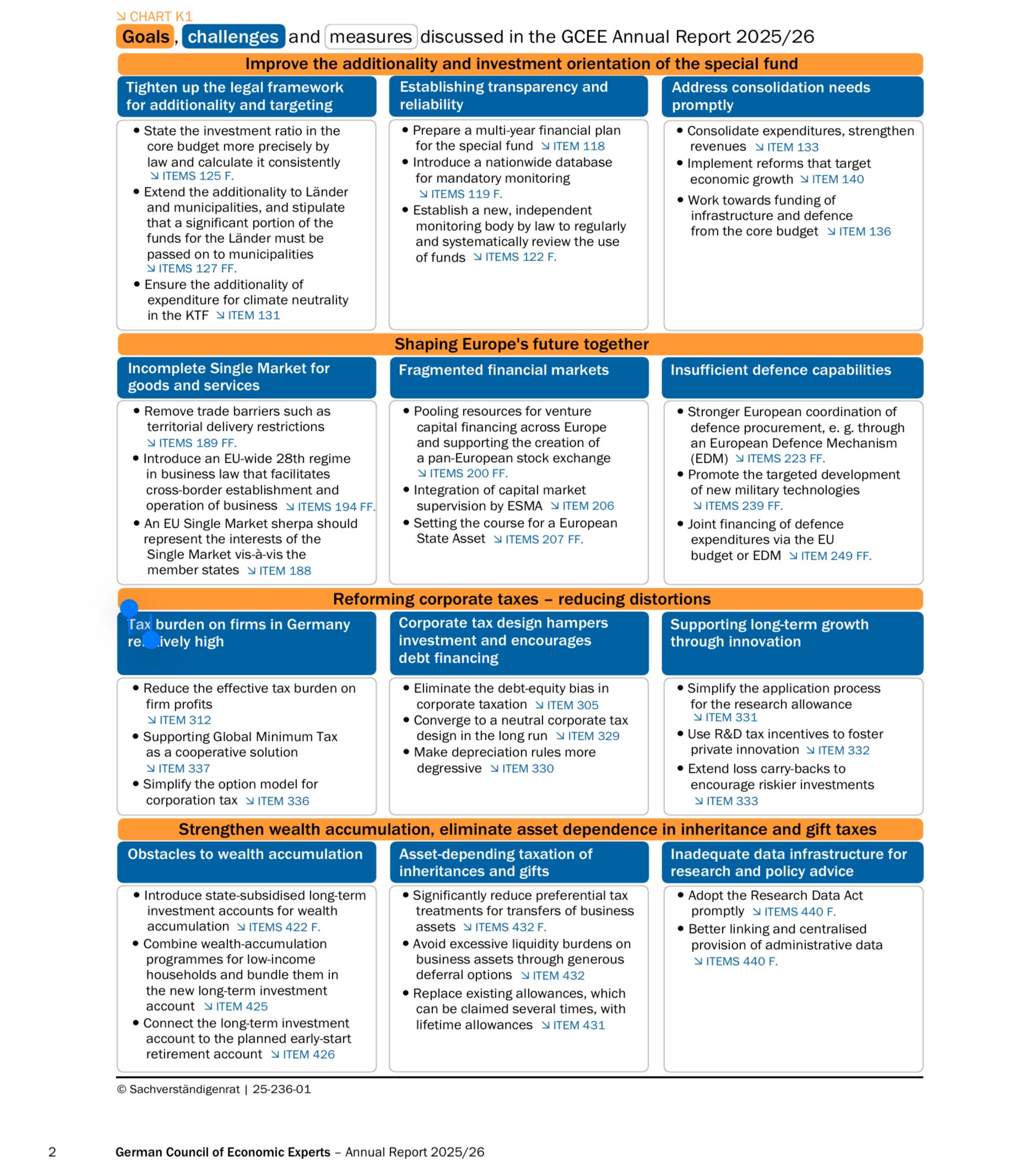
On its own, none of the single measures advocated for would be able to trigger a virtous cycle. What the experts are in fact urging is a holistic effort both at the national and European level. Doing it all would inevitably take time.
At the European level, the German president of the EU commission, Ursula von der Leyen, is already doing her utmost to support Merz by accelerating the simplification of common rules. But she, too, has to contend with the fact that even measured against the table above, so far most of her deregulatory agenda has been aimed at dismantling her own recently introduced green reporting standards for smaller companies. And it is easier to undo fresh rules than to step into well established no go areas.
In fact, how likely is it that the commission will succeed in breaking down national barriers that member states, including Germany, are much more reluctant to relinquish? How about the introduction of a 28th regime in business law to facilitate the establishment of cross border businesses? Or « setting the course for a common European safe asset », as highlighted in the table above?
There is no sign Merz might embrace such controversial ideas. And the problem for him has always been that Germans only reluctantly agreed to give him a chance to lead the country. Many share his traditional conservative ideas about the economy and migration. Few like his style. The result is Germans are demanding quick fixes to problems that have accumulated over years, sometimes decades.
But if Merz managed to push through tougher medicine, patients would balk because they don’t like the doctor. When instead, the chancellor puts a premium on compromise, as he is doing, public opinion seems to react as if the country was gripped by paralysis. It starts to look like Merz has chosen an impossible task.