
Saving public money
How the debate on the digital euro and stablecoins are part of a larger story - a shorter version of this essay was published by the American German Institute https://americangerman.institute/2025/11/

At a recent hearing before the European Parliament, Piero Cipollone, the Executive Board Member of the European Central Bank (ECB) in charge of the digital euro project, reminded his audience why « the digital euro is not merely a technical undertaking – it is a vital, forward looking step to ensure that central bank money continues to serve Europeans in an increasingly digital world. » Cipollone and his colleagues at the ECB have their work cut out for them. Many European banks have resisted the project from day one, wary a digital euro might cost them customers and revenue. Even in the European Parliament there is skepticism.

In essence a digital euro is meant to extend the benefits of cash to digital payments. Cash is still a popular means of payments in some of the biggest EU member states, such as Germany or Italy. But according to the ECB online payments now account for at least one third of all day to day purchases in Europe and their role continues to grow fast. This trend is described as the dematerialization of money. It poses a threat to cash. By pushing for the introduction of a digital euro the central bank is in essence trying to throw cash a lifeline.
For European authorities the wake up call to this new reality occured when the company Meta, then Facebook, announced its own plans for a privately issued cryptocurrency in 2018. At the time the social media group’s grandiose attempt at changing the nature of money disintegrated against a political and regulatory wall both in the U.S. and in the European Union. But their two central banks drew vastly different conclusions from that experience.
In the US the Federal Reserve, issuer of the main global reserve currency, concluded that its predominant role in the global financial system could not be easily challenged. While some exploratory work on a digital dollar was carried out, the Fed ultimately did not see a compelling need to move forward decisively[1].
In Europe instead, the ECB recognized that having successfully staved off one attempt, did not mean the broader trend was going to be reversed. Discussions on a digital euro were already under way, but the idea of a European CBDC gained urgency because the monetary union is still more vulnerable than the US. Especially, given that the wide adoption of digital payments means that online transactions in Europe have come to depend on non-European private payment providers, such as VISA or Mastercard.
If the role of cash became marginal, the balance between public and private money could be undermined. This matters because central banks only issue public money, cash. It is commercial banks that create private money. They do so by extending loans. Central banks do of course influence the creation of private money by setting interest rates and they provide liquidity to traditional credit institutions, especially when the plumbing of the financial system malfunctions. But they have less control over the non-banking system. Digital payment service providers are not banks. But their growth into activities that resemble deposit taking and lending has increasingly blurred the lines between traditional banking and non-banking activities. So far, European banks have been slow to respond to the challenge. Various attempts at setting up their own integrated, private cross border payment services have floundered.
The recent hype about stablecoins, a private digital asset that mimics a currency has added a new source of disturbance and compounded the sense of urgency with which the ECB is pursuing its plans. The worry is the currency union may risk undermining parts of its monetary sovereignty, in other words the central bank’s ability to respond to financial shocks and/or changes in price developments, its two core functions.
Dutch central bank governor Olaf Sleijpen recently told the Financial Times that “If stablecoins in the US increase at the same pace they have been increasing they will become systemically relevant at a certain point”.
Stablecoins are crypto assets pegged to major currencies, such as the dollar or euro. Importantly, these tokens promise to hold their value against their underlying currency. To ensure stablecoins are truly redeemable at all times at par, issuers buy safe assets, mostly short-term government bonds, typically US treasury bills. So far, all major offerings of stablecoins have been dollar denominated. They are creating an important source of demand for US ‘safe assets’, treasury bonds. Congress has recently created the legal framework to regulate crypto assets, such as stablecoins. What is called the ‘genius act’ in the US is called MICA (Markets in Crypto Assets) in Europe. Both laws are intended to streamline the adoption of crypto assets and move them from their infancy into a more settled, legally sound phase. Both regulations recognize the growing role of such assets.
Stablecoins can be useful to park liquidity in the crypto space. But they can also be used to transfer small or large sums quickly around the globe (without proper anti money laundering controls). Some critics say the use-case for stablecoins is limited, others respond that it represents a serious challenge to traditional and usually costlier ways of transferring funds across borders via banks. If stablecoins were widely adopted, they could even step into the same grey area, between banking and nonbanking activities, in which traditional commercial credit institutions and payment providers already compete. They could represent a potentially important chapter in the dematerialization of money story.
Their success could not only complicate life for the main current issuers of private money, banks, but also impact the issuance of safe assets, US treasuries. How? By adding a source of demand for treasuries, they could potentially distort price signals in the sovereign bond market, crucially at a time when investors are increasingly worried about the precarious fiscal position of the U.S. government. In other words, if successful, stablecoins, another form of private money, could ultimately contribute to cement the ‘exorbitant privilege ‘of the U.S. public money, the dollar, and strengthen the role of it’s underlying ‘safe asset’, U.S. government bonds. This is exactly what backers of stablecoins within the US administration hope will happen. The fact that tokens are already one of the main sources of demand for short-term U.S. debt today, as highlighted by a group of economists in a recent paper, seems to bolster their case. https://www.nber.org/papers/w34475
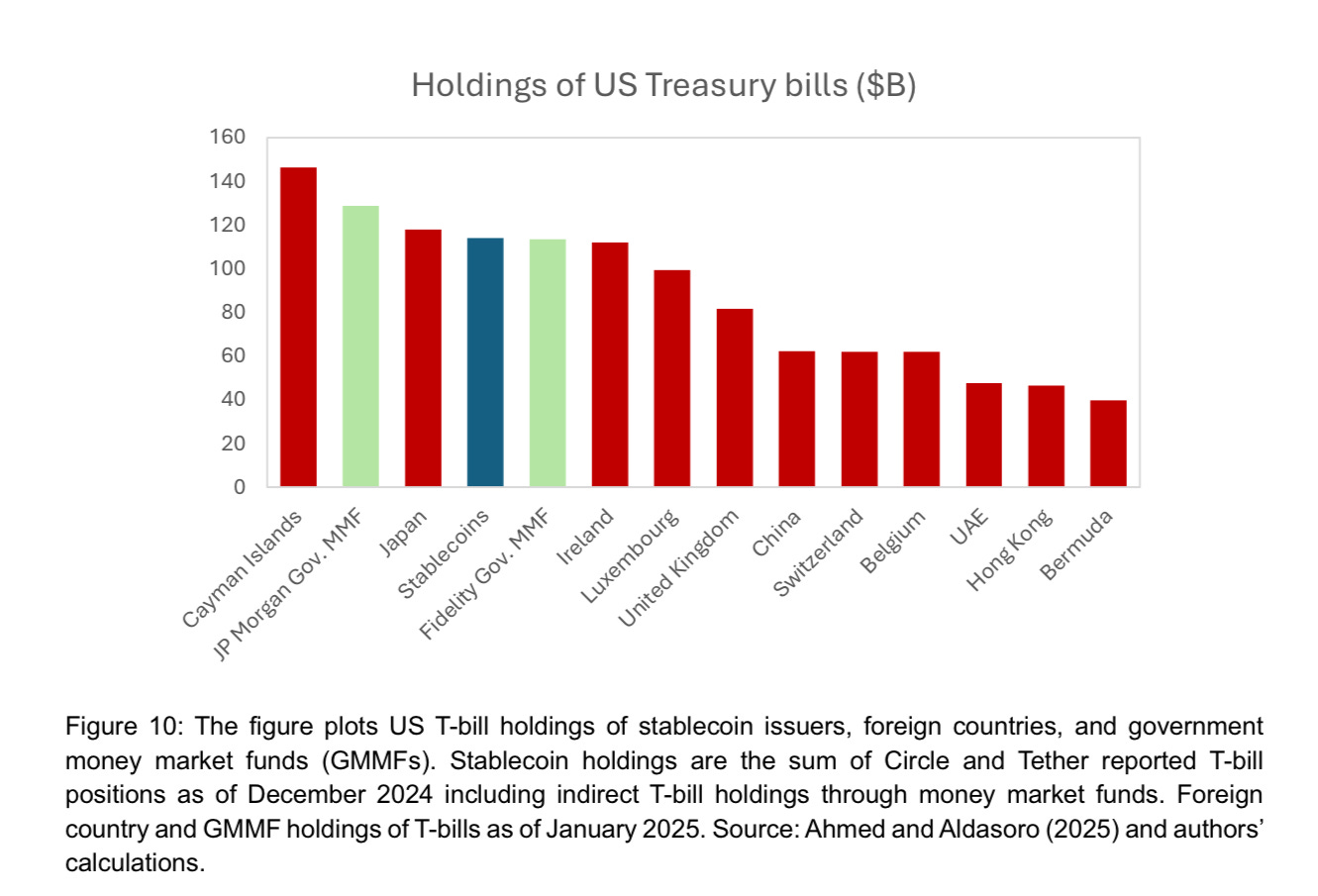
However, in times of market stress demand could evaporate. What appears to be a source of support for short term government debt in normal times, could just as quickly turn into a threat to it, and to financial stability. Would traditional central bank tools still be sufficient to respond effectively? It is unclear. According to the Bank of International Settlements, an international body representing central banks, “The prospect of broader use of foreign currency-denominated stablecoins has (…) prompted questions about monetary sovereignty.” Why? “Broad-based stablecoin adoption could provide seamless access to dollar-denominated claims for non-US residents, potentially weakening the effectiveness of domestic monetary policy.” https://www.bis.org/publ/bisbull108.pdf
Of course, the impact of the loss of monetary sovereignty in smaller jurisdictions would be less severe in the second largest reserve currency, the euro. However, financial markets are interconnected. Even the European Central Bank would be affected by widespread problems in other jurisdictions.
Thus, when the very nature of money and the future ability of central banks to respond to financial stability threats are in flux, it would be a mistake to reduce the introduction of a digital euro to a pet project of a few central bankers that want to step into private payment systems. Instead it is one way, and by no means the only one, to weatherproof the single currency.
Of course, if European leaders genuinely believed that recent developments in the financial system posed a potential danger to the euro area and its economy, they would also overcome their resistance to talk about the need to issue a truly, common European safe asset. To be sure, the digital euro represents one possible European response to the digitalization of Europe’s financial system. But the best way to ensure the currency area’s long-term viability, even in the age of digital money, is to reduce the fragmentation of Europe’s financial system, of its banking sector as well as its capital markets. Crucially, to do that means overcoming resistance against pooling more resources. If the single currency area was able to issue its own truly common safe asset at scale, this would ensure a leading role for the single currency. Perhaps, the whole debate over a digital euro would be much less controversial than it currently is.
[1] https://www.federalreserve.gov/publications/files/money-and-payments-20220120.pdf